

It doesn't matter who you are, or where you come from, or what you look like, or who you love...
How Keith McIvor (JD Twitch) gave me the space to know myself

The last month has been a very discreet but important experience of loss and mourning for me. It’s been both quite shit, but also quite contained for many reasons.
It centres around two men I’ve known and been around the last 10-20 years, and I want to give them both a bit of space here to remember them, and recognise and realise what they have gifted me in their own ways.
If you are Scottish - or from the British Isles in general - and into music, you will have no doubt read about the death of Keith McIvor, otherwise known as JD Twitch.
He was one half of the seminal DJ-duo, Optimo. Lauren Martin wrote a beautiful piece in the Guardian about him, I would recommend it. Resident Advisor also wrote a comprehensive record of his incredibly musical life. They are great places to learn more about Keith, or reminiscence about his parties.
But personally, after learning of his death, I’ve been thinking about the lasting impression, or rather the deep impact, that Keith had on me. I’m very grateful to him, and there’s nowhere to really put that gratitude now, so I’m writing this.
His life, his presence and contributions to culture isn’t just an interesting thread of music and self‑expression; I think Keith - and Jonnie Wilkes for that matter, as the other half of Optimo - also offered and generated for me, a lasting kind of acceptance in life.
Let me explain.
Dialling back to the mid-1990s - and apologies for the niche Scottish club scene references that few will get - I first heard the music Keith played at Edinburgh night club Pure when I was about ten years old.
My older brother, six years older, was a teenager who went to the emerging dance club nights Pure and Tribal Funktion. 16 year olds in drug-fuelled, boundless underground club culture is a wild memory. I know. It was a different time.
Being my older brother, he would batter me for ever entering his room and touching his stuff, but I loved the flyers and other paraphernalia he collected from those club nights. I used to look through his stuff and can still recall the Pure logo on neon‑paper flyers.
As a ten‑year‑old, I obsessively admired these fleeting objects from nights I never attended, while my brother played tapes, CDs and records of that music- which I was subjected to, mostly through the walls of our joining rooms. It was euphoric, ascending and descending, relentless but rhythmic.
To my young mind, it all felt very genuine, real. Not like the pretty but bland pop music I would get otherwise on Radio 1.
But fast forward to the 21st century and later when I went to the Art School in Glasgow in 2003, my girlfriend at the time started going to his club night that was on every Sunday night.
I remember her coming home around 3 in the morning one night in November and saying, “you really have to go; you’ll love this place. They play everything. It’s music for everyone.”
I was a stubborn bastard and, because I didn’t like her friends, I didn’t want to go.
It remains genuinely one of the few regrets of my life. Because it meant I missed out on listening to Keith and Jonnie as Optimo for the first two years of my time in Glasgow.
I didn’t want to go to this mysterious Sunday night club night - Optimo - because.. of her friends? Sure. But I realise now I didn’t want to go because… it felt dangerous.
I see now, I was actively avoiding it.
My girlfriend explicitly said I’d love it, yet their flyers literally said:
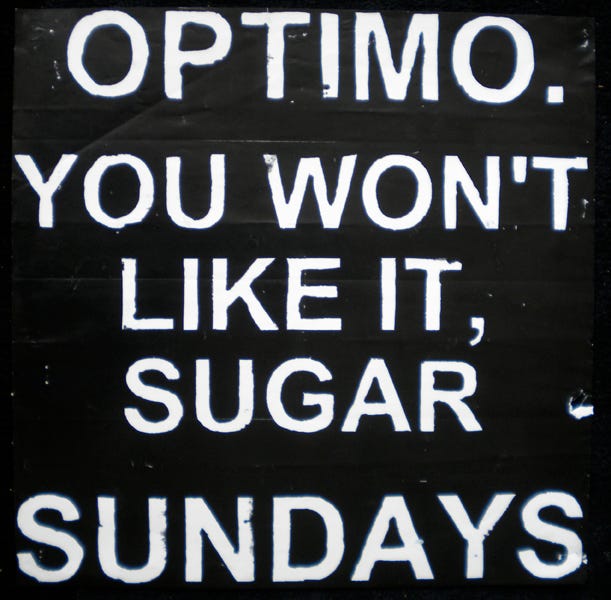
When I saw those posters around Glasgow I genuinely wondered why they didn’t want me there.
To be sure: Everyone I knew who went there was beautiful. Tasteful. Wild. It was super sexy, and very much on the edge of things. It was, without a doubt, cool.
But in that, I think there was something about that very specific Glasgow subculture – a genuine feeling of belonging – reinforced by the fact that it was held in the basement of a club (the Sub Club) on Sunday nights of all things, that felt especially dangerous to my 18‑year‑old mind. A mind suffering from low self‑esteem and detached connection the world.
Because in 2003, I was still in the absolutely depths of grief over the death of my best friend from the year before, and I see now I had such a heightened sense that there was nowhere for me, anywhere. I felt very alone in the world.
So I stayed away from Optimo - and anything like it - for a long time.
Nevertheless, in the mid‑2000s Optimo was the substrate under which everything at Art School was tuned. It didn’t matter that I didn’t go. Everyone else did. It sounds a bit cheesy, but it’s almost like what the Factory was to New York, or what the Hacienda was to Manchester. Optimo, on Sunday nights.
At the Art School, the design, fine art and architecture schools formed distinct groups. Tribes. You could spot the textile girls, the fine art guys, the product design girls, the architecture lads. They all wore different uniforms, styles, exhibited different tastes, different attitudes.
Optimo, however, brought not just all of the Art School together, but all of Glasgow together: art‑school students, party‑heads and everyone else who had a job but hated it enough to turn up hungover and half cut on a Monday morning.
So it’s perhaps not a surprise that when I finally started going around 2006, it felt strangely familiar.
A friend from primary and secondary school worked behind the bar at the Sub Club, so it always felt like coming home, like coming back to myself. (You have to remember that the differences between Edinburgh, where I’m from, and Glasgow, where I lived, are about as far as you can get culturally, within a 45 mile radius, so this meant something).
So there was this strange pulling tension between belonging, familiarity but also expansion and exploration.
It was a place where everyone could be themselves while also being together. (And I say this as someone who was sober during that time, so there is no hazy, ecstasy‑induced memory involved here). It felt amazing.
Later that year, at a house party I met girl who came to Glasgow, on exchange from Sweden.
She studied textiles, and I fell head over heels for her; she blew my mind with her beauty, intelligence and taste. She came to Glasgow because of Optimo. She was quite active on the Optimo website bulletin board and knew Jonnie and Keith through her love of No Wave. Keith even referred to her as No Wave Anna.
She would go every Sunday night, and she used to say – and I agreed – that the first hour was always the best. Because it was the weirdest stuff, starting at 11 pm when there weren’t many people in and the music was different. It was weird. It went everywhere.
But at the club it was intoxicating enough just to have that mixture of safety - to know you could relax into yourself - but also challenge yourself in new ways. Everyone was included, every style and taste was welcome. There was no pretence. No showboating. No hierarchy. No bullshit.
So Keith and Jonnie, through music and their nights, invited me to discover parts of me – different atmospheres, combinations, feelings, textures and emotions – through endless variation of sound and music.
I think that is what I was intuitively scared of all those years before. I see it now as almost music-fuelled shadow work: what you fear the most is where you really need to go.
There was something electrifying about Jonnie and Keith playing; it gave me permission on the dance floor, in the club, to feel things that might otherwise seem dangerous. All sides of myself, through all musical flavours, had their space.
That might sound odd, but it’s how it felt to me, as a wounded, scared young man, unsure of his place in the world.
I don’t know if anyone else felt that, but in reflection that’s what I think I found in Optimo, and why I feel the grief I do.
Keith - and Jonnie - helped me become more of myself.
When I moved to London in 2007, I struggled to enjoy clubs and music in the same way. It always felt more two‑dimensional and surface‑level in comparison to the richness of a Sunday night at the Sub Club with Optimo.
Glasgow clubs and crowds are overwhelmingly better than elsewhere, and I did evenetually discover amazing nights like World Unknown and Disco Bloodbath during my early years in London, they always felt like Optimo-clones.
But when Optimo came to London, Scots and Glasgow-exiles turned up like moths to a flame. It was a best way to feel at home.
I was very homesick, so their radio shows and internet mixes kept me strongly connected to home. Many, many people have found Optimo to be the home they needed and wanted, and that was always true for me.
What I found very sad about Keith’s death is that he and Jonnie created spaces that brought me into contact with people who made my life worth living, and it has been painful to have to accept that those spaces will be diminished without him.
Though let it be said that Jonnie keeps the spirit alive as Optimo, and I cannot wait to dance at another Optimo night soon. It will be cathartic to be sure.
But what they did together, for the formative years of my young adult life, was create that substrate that let me feel joy and see life as something worth exploring and enjoying. All through the darkness of a night club and the melting shifting sequence of music and song.
There’s something about the way Keith played music that I was fascinated by when we created Cove. Namely music’s ability to express rich, layered emotions.
Keith’s mixes always had a very layered, nuanced feeling. DJing is essentially blending or segueing between tracks, but his the choice of contrasts—sweet and sour, happy and melancholic—creates rich feelings that are hard to match.
I have favourite mixes where, for seconds or minutes, Keith would blend two (or more!) songs and an incredible life force would emerge and vibrate, producing a euphoric or bittersweet mood that turned positive.
Keith and Jonnie do that better than anyone else. It’s hard to remember that it wasn’t always like that. In that sense, they are the trailblazers. Although I’m not a technical person, I also get the sense that it was Keith’s use of Ableton gave his mixes a unique quality.
Beyond the music, Keith embodied the best spirit of humanitarianism, one that operated a local Scottish level: pretty tirelessly working with food banks, supporting community initiatives, creating music labels, supporting local artists and musicians. If you had a burgeoning night on in Glasgow, or Scotland, he always seemed to be happy to play at your night, to help things along.
I was always deeply aligned with him on all things politics. I think it helps we come from the same part of Scotland, and although much older, we tracked with similar upbringings.
There was a fire to his politics, but also a gentle Scottish spirit – quiet, inquisitive, creative – that people often overlook, especially on the East Coast where Keith and I are from.
In this way again, he made me feel a lot better about being me, and I always looked up to him as a wonderful man that made a lot of people happy and had such a moral compass to navigating our world. It all based on the simple fact that music could change our world. I know he changed mine.
And that’s what’s been difficult for me, these last couple of weeks, digesting these deaths. Both Keith’s death and another important man in my life, John Morgan, died very soon after each other, and the poignancy is the grief of knowing someone important has died and there’s nothing left of them to receive and see again, but that I can see clearly the gifts they gave me and the realisation that brings.
So if you enjoy the music that Keith and Jonnie put together and made as Optimo, or ever went to Optimo, I mourn with you, with Jonnie and with Keith’s family and all their friends.
Post-script
I’ve you’ve never heard any of Keith’s music and mixes. Here are my all time favourites:
White Light #54 might be one of my favourite mixes of all time. It’s an auspicious one, about reclaiming ‘trance music’ to its origins. But it holds - in my mind - the most transcendental mixes between 2 songs I’ve ever heard. I won’t say where it features, so just take some time out of your time to listen to this all the way through. You won’t regret it.
Optimo Podcast #1: Synth Summer (2009) This is so old they called it a podcast, even though it’s a mix and doesn’t have anyone chatting away on it. But it was the first in a string of incredible mixes Keith and Jonnie released that didn’t have any track listing, it was just a musical journey to enjoy. It is incredible.
Walkabout (2007) was the soundtrack to my final Spring in Glasgow. The vibration of Boris’ My Machine felt - and still does feel - like a certain kind of release into blissful peace. While Thomas Brinkmann’s Monomexico is entrancing.
The Essential Mix (2006) was the one I think that helped break Optimo out of Scotland with regards to the mainstream awareness of them. Its epic.
Optimo Sub Club x Boiler Room (2014) opens the best possible way, with some Scottish folk songs, Isao Tomito and some 80s J-Pop, all set in the bowels of Glasgow’s Sub-Club. Watch the crowd slowly fill the room, that could be any night between 1997 and 2010.
Thanks for reading, I appreciate it. If you ever went to Optimo, I’d love to hear your stories…